Myasthenia Gravis Homeopathy Treatment and Its Homeopathic Medicine
What is Myasthenia Gravis (MG)?
The term Myasthenia gravis means ‘grave muscle weakness’. MG is a chronic progressive auto-immune disorder causing muscle weakness.
What happens in MG?
In MG, there is weakness of voluntary muscles (those controlled by will) and easy fatigability. This weakness comes up during periods of exertion and improves after rest. MG is an abnormality of the transmission of signals at the Neuro-Muscular Junction (NMJ). (Signals travel from brain to muscles via the nerves and the place where nerve joins muscle is called neuro-muscular junction.)
Whom can it affect?
- Females are affected more often than males
- Age of onset in females is during second to third decade
- Onset is after sixth decade in males
- 2 out of every 100000 people are affected by MG
Auto-immune nature of MG:
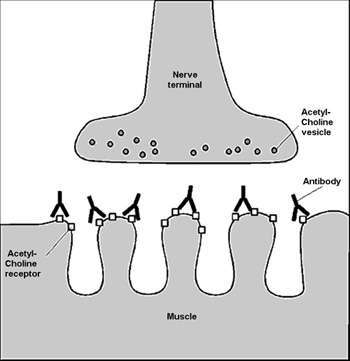
- In MG, the body’s defense system forms cells (antibodies) against acetyl choline receptors
- These receptors are required for transmission of signals across the NMJ
- When these receptors are blocked, altered or destroyed by the antibodies, muscle contraction cannot occur normally.
Causes of MG:
- Genetic
- Immunological
- Thymus tumors or abnormal enlargement (hyperplasia)
- Stress (aggravating factor in existing cases of Myasthenia Gravis)
Muscles usually affected by MG:
- Muscles controlling eye and eyelid movements
- Muscles of facial expression
- Muscles of swallowing
- Neck and limb muscles
- Occasionally respiratory muscles
Symptoms of MG:
- Drooping eyelids (ptosis)
- Double vision (diplopia)
- Difficulty in speech, slurred speech
- Difficulty in swallowing
- Nasal sounding speech
- Weakness of neck muscles
- Weakness of arms and legs
- Symptoms are usually intermittent (i.e. come and go)
- Symptoms may disappear for weeks and may appear again, later
- Weakness tends to worsen as the day progresses and after prolonged activity
Myasthenia Crisis:
- A condition in which respiratory muscles become severely weakened
- Patient may have breathlessness, choking, aspiration of food
- Myasthenia crisis is rare and may end in respiratory failure
Grades of MG:
- Grade 1: Only ocular disease
- Grade 2A: Mild generalized weakness
- Grade 2B: Moderate generalized weakness
- Grade 3: Severe generalized weakness
- Grade 4: Myasthenia crisis
Triggers of Myasthenia Crisis:
- Respiratory viral infections
- Sudden withdrawal of steroids
- Certain drugs
- Psychological stress
- Pregnancy
- Exertion (especially in hot climate)
Diagnosis of MG:
This is mainly based on clinical findings and a few supportive investigations:
- Antibodies to acetyl choline receptors
- EMG (Electromyogram)
- Repetitive nerve stimulation
- Tensilon test
- CT chest (for thymus abnormalities)
Allopathic treatment mostly includes:
- Acetylcholine esterase inhibitors (Pyridostigmine)
- Steroids
- Immunosuppressive drugs
- Plasmapheresis (a procedure in which abnormal antibodies are removed from the blood)
- Intravenous immunoglobulin (temporarily modifies the immune system and provides the body with normal antibodies from donated blood)
- Surgical treatment: Thymectomy
Homeopathic approach and scope:
Myasthenia Gravis is an autoimmune disorder, which means that there is a fault with the immune system, guided by genetic tendencies and other general factors. In other words, MG is a constitutional disorder, where the whole constitution needs to be addressed. MG is a progressively deteriorating condition, calling for some measures to arrest or control the disease process. Homeopathic treatment being constitutional in nature, treats the disease at a deeper level, to achieve the following:
- Control of the disease process
- Symptomatic relief
Homeopathy has shown its efficacy in reducing the frequency of relapses and improving the power and tone of muscles. However, it may be noted that the improvement with homeopathy may not be as fast as one achieved by using the immunosuppressive medicines. The role of homeopathy is more as long term control, rather than for acute crisis control. Homeopathy with its constitutional approach works at deeper level and brings deviations of immune system back to normalcy and in consequence minimizes the need of exogenous neurotransmitters or steroids as prescribed by conventional treatment.
Suggestion about homeopathic treatment:
For achieving the best results in the cases of MG, we recommend a strategic combination of homeopathy with the conventional treatment.
Written & Approved by-
Dr. Rajesh Shah
M.D. (Hom.)