Beyond Fixity and Prejudice
The approach of understanding a remedy through its well known fixed image/picture alone, very often limits the homoeopath's vision, understanding and application of the physician, in his endeavor of unprejudiced perceiving.

Beyond Fixity and Prejudice
by Dr. Rajesh Shah and Dr. Rupal Shah
Homoeopathy Times, Vol.1 No.2 June 1994
Dear reader,
The approach of understanding a remedy through its well known fixed image/picture alone, very often limits the homoeopath's vision, understanding and application of the physician, in his endeavor of unprejudiced perceiving.
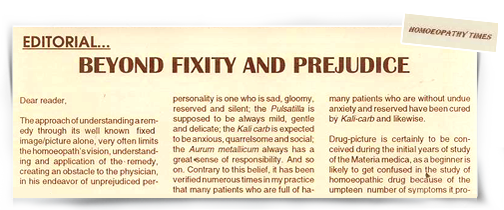
Application of materia medica based on fixed images helps to treat many cases successfully but to get stuck up in the understanding of the remedy in that narrow fashion which prevents the physician to recognise those patients who do not fit into the popular known image of the remedy definitely hinders him in his mission to treat judicially and rationally.
The fixed image of the Natrum-mur personality is one who is sad, gloomy, reserved and silent; the Pulsatilla is supposed to be always mild, gentle and delicate; the Kali carb is expected to be anxious, quarrelsome and social; the Aurum metallicum always has a great sense of responsibility and so on. Contrary to this belief, it has been verified numerous times in my practice that many patients who are rash, abrupt, rigid and non-weepy have been cured by Pulsatilla; many patients who are without undue anxiety and reserved have been cured by Kali-card and likewise.
Drug-picture is certainly to be conceived during the initially years of study of the Materia medica,as a beginner is likely to get confused in the study of homoeopathic drug because of the umpteen number of symptoms it produces in drug proving. Hence the importance of Kent's Materia Medica consisting of comprehensible drug-pictures. The controversy does not lie in ignoring the idea of drug image which serves as a good tool in the study of vast number of homoeopathic drugs. But the point to stress is that after initial grasp, homoeopathic drugs must then be studied in their broader perspectives i.e. beyond the fixed images. In reality, as I understand the remedies can not be understood sufficiently by way of any fixed images.
A dangerous source of such fixed knowledge about the remedies come from past experiences with the remedy ! It is several fold risky when such experience based information is passed on by a teacher ! Teachers often transmit their experiences (especially) with small remedies based on their small experience in one or two cases. In turn, a crowd of several hundreds of homoeopaths receive prejudiced fixity about that remedy identical to that of the teacher. And the trouble begins when the homoeopath ultimately puts that knowledge into practice and looks forward to having a patient with the image of the remedy that he has learnt. This problem gets accentuated in case of novice, the enthusiastic students who lack practical experience.
Any fixed image about the remedy as I strongly believe is, nothing but a facet of the remedy. And we should cultivate vision to see other facets of remedies. This exercise, undoubtedly, enhances our ability to prescribing.
If we go unbiased through the source books, we shall be able to prescribe remedies beyond the fixed images. I assure you that you will have a thrilling joy in prescribing remedies the way you may not have imagined them to be.
The most effective and logical argument against the fixed images about the remedies is that remedies do not produce any fixed images in the drug-proving. They just produce a specific distrurbance manifested by a group of symptoms in the prover.
Recalling the story of an elephant and seven blind men, recognising and defining the elephant as a pillar, a rope, etc. An elephant in the story is a simile. Let us proceed towards opening our eyes and viewing the elephant in toto. Think again !
Thank you for the overwhelming response to the first issue of HOMOEOPATHY TIMES, which was read by homoeopaths in twenty nine countries. Thank you for appreciating thought-provoking, shaking and bold journalism in homoeopathy.
-Dr. Rajesh Shah
-Dr. Rupal Shah